|
LOOKING TO APPOINT DISTRIBUTORS, DEALERS, OR FRANCHISEES
FOR YOUR BRAND? Visit India's #1 MSME Distribution Platform: https://indiadistributor.in/ Call / WhatsApp: +91-7428650430 |
Email: support@indiadistributor.in |
Every business owner in India has, at some point, asked themselves: What is the difference between manufacturers vs. distributors vs. wholesalers vs. retailers? It sounds like a basic question. But the answer to this question — when truly understood — can change how fast your brand scales, how much margin you retain, and how many markets you reach.
Whether you manufacture a food product in Gujarat, run a healthcare brand out of Delhi, or sell home care items from a small unit in Maharashtra, understanding the difference between a manufacturer distributor wholesaler retailer is the foundation of any serious distribution strategy.
In India alone, the FMCG distribution network touches over 8 million retail outlets through a chain of manufacturers, distributors, wholesalers, and retailers. According to a 2023 KPMG India report, the total value of India's distribution economy is estimated at over Rs. 4.2 trillion. And yet, most MSME brand owners cannot clearly articulate what is the difference between manufacturers vs. distributors vs. wholesalers vs. retailers in practical terms.
That confusion costs real money. It leads to wrong channel selection, margin leakage, territory conflicts, and slow growth. This blog from IndiaDistributor.in is designed to fix that — once and for all.
By the time you finish reading this guide, you will know exactly how each player in the supply chain works, what role manufacturers vs. distributors vs. wholesalers vs. retailers play in getting products from factory to consumer, and how you can use this knowledge to grow your MSME brand faster.
Manufacturers vs. Distributors vs. Wholesalers vs. Retailers
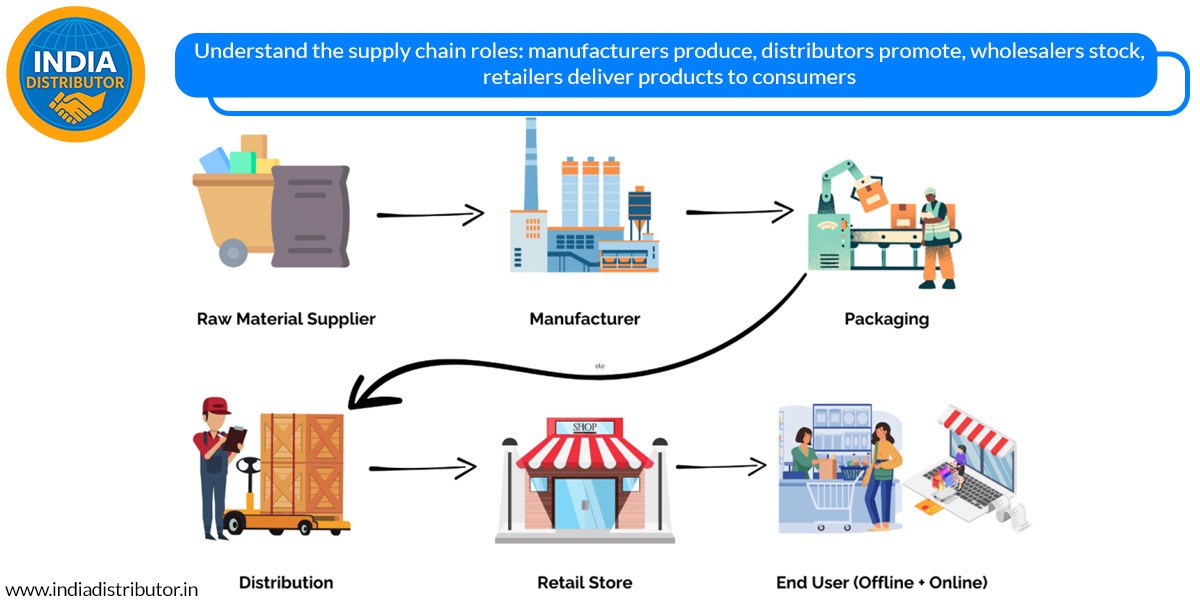
Let us start with the most searched question in Indian trade circles: what is the difference between manufacturers vs. distributors vs. wholesalers vs. retailers? The answer lies in four things — where they sit in the supply chain, who they buy from, who they sell to, and at what price.
Here is the simplest way to see it:
• A manufacturer makes the product.
• A distributor takes the product from the manufacturer and pushes it to a wider market territory.
• A wholesaler buys in very large quantities from distributors or manufacturers and resells to retailers.
• A retailer sells directly to the end consumer.
Now let us go deeper, because what is the difference between manufacturers vs. distributors vs. wholesalers vs. retailers goes well beyond this four-line answer.
The Manufacturer: The Origin of the Supply Chain
A manufacturer is any individual, firm, or company that converts raw materials into finished goods. In the context of manufacturers vs. distributors vs. wholesalers vs. retailers, the manufacturer sits at the very top of the pyramid. Manufacturers in India range from small MSME units producing 500 kg of goods per month to large enterprises with pan-India production capacity.
Manufacturers typically sell in large, bulk quantities at ex-factory prices. They focus on production, quality control, and building their brand. They do not — in most cases — handle last-mile distribution themselves. That is where distributors come in.
Key data point: As of 2024, India has over 63 million MSMEs, a large proportion of which are manufacturers. Yet fewer than 20% of them have a structured distribution network beyond 200 km of their base location. That is a massive growth gap — and it is exactly what IndiaDistributor.in was built to close.
The Distributor: The Market Builder
When discussing manufacturers vs. distributors vs. wholesalers vs. retailers, the distributor often gets the least attention. That is a costly mistake. A distributor is the bridge between the manufacturer and the broader market. A retail distributor meaning in practical terms is: an entity that holds a defined territory, maintains a stock of the manufacturer's products, and services a network of retailers and sometimes wholesalers within that territory.
Distributor vs wholesaler is one of the most confused comparisons in Indian trade. Here is the critical distinction: a distributor typically has an exclusive or semi-exclusive agreement with the manufacturer for a specific region. A wholesaler buys from anyone — manufacturers, distributors, or importers — and sells to anyone who buys in bulk.
In the manufacturer vs distributor vs retailer model, the distributor earns a margin of typically 5% to 15% depending on the product category, investment level, and market support provided. According to IndiaDistributor.in's internal data from over 500 listed brands, the average distributor investment requirement in India ranges from Rs. 50,000 to Rs. 10 lakhs depending on category.
The Wholesaler: The Volume Engine
In the debate of manufacturers vs. distributors vs. wholesalers vs. retailers, the wholesaler plays a pivotal but often invisible role. A wholesaler and retailer are frequently confused — especially in tier-2 and tier-3 Indian markets where the same trader might act in both capacities.
A wholesaler buys goods in very large volumes from distributors or directly from manufacturers, then resells them to retailers or bulk buyers in smaller lots. The wholesaler vs retailer distinction is clear: the wholesaler never sells to individual consumers. Their business is purely B2B.
Wholesalers operate at thin margins — typically 3% to 8% — but compensate through volume. In the FMCG sector, a single Delhi-based wholesaler in areas like Chandni Chowk or Khari Baoli handles goods worth Rs. 50 lakhs to Rs. 5 crore every month.
The Retailer: The Consumer-Facing Layer
In the full spectrum of manufacturers vs. distributors vs. wholesalers vs. retailers, the retailer is the last link — and in many ways the most powerful one. Retailers sell directly to end consumers, either in physical stores or through e-commerce platforms.
The wholesaler and retailer are often grouped together in casual conversation, but they serve completely different functions. A retailer maintains customer relationships, drives brand visibility, and earns the highest per-unit margin in the chain — typically 20% to 50% on most FMCG and consumer products.
There are currently over 14 million retail outlets in India. This is the final battlefield where every manufacturer, distributor, and wholesaler is ultimately competing for shelf space and consumer attention.
The table below summarises what is the difference between manufacturers vs. distributors vs. wholesalers vs. retailers across eight key parameters. Print it, save it, share it with your team.
Source: IndiaDistributor.in internal data, KPMG India Distribution Landscape Report 2023, Nielsen India Trade Survey 2023.
What is the role Manufacturers vs. Distributors vs. Wholesalers vs. Retailers?
Understanding what is the role manufacturers vs. distributors vs. wholesalers vs. retailers play is not a theoretical exercise. It directly affects your go-to-market strategy, your pricing, and your speed of growth. Let us break it down role by role.
Role of the Manufacturer
The manufacturer's role in the manufacturers vs. distributors vs. wholesalers vs. retailers ecosystem is to create, produce, and supply. But in today's competitive market, a manufacturer must also build a brand that distributors and retailers want to carry. A product without brand pull is difficult to push through any distribution channel.
Manufacturers who partner with IndiaDistributor.in benefit from a structured system that directly connects them with verified distributors and franchise partners across 28 states in India — without cold calling, trade show dependency, or months of wasted outreach.
Role of the Distributor
The distributor's role in the manufacturer distributor wholesaler retailer chain is to create geographic reach and market penetration for the brand. A good distributor does not just move boxes. They build relationships with retailers, handle credit, manage returns, and provide real-time market feedback.
Retail distributor meaning in operational terms: a distributor handles the last mile from factory to the retailer's shelf at scale. Their investment in vehicles, warehouse space, manpower, and working capital is what makes mass-market distribution possible for a brand that could otherwise never reach 500+ retail outlets on its own.
Role of the Wholesaler
In the manufacturers vs. distributors vs. wholesalers vs. retailers chain, the wholesaler provides a crucial buffer. They aggregate demand from small retailers and provide a price-efficient channel for moving large volumes quickly. In categories like food grains, spices, and household products, the wholesaler and retailer together account for 70–80% of total market coverage in non-urban India.
The wholesaler vs retailer distinction becomes critical when brands are designing their pricing architecture. If your trade margin from the manufacturer to the wholesaler is too tight, the wholesaler will drop your product for a competitor.
Role of the Retailer
In the manufacturer vs distributor vs retailer picture, the retailer is the brand ambassador. They decide what goes on the shelf, what they recommend to the customer, and what they actively push. Retailers earn the highest per-unit margin because they carry the highest risk — unsold inventory, customer returns, and working capital lock-in.
With e-commerce growing at 27% CAGR in India (Redseer Strategy Consultants, 2024), the role of the retailer is evolving. Online marketplaces are becoming a new class of retailer — and brands that understand the selling item from distributor to retailer is B2B or B2C distinction are better positioned to design hybrid channel strategies.
Distributor vs Wholesaler — Why This Confusion Costs Brands Crores
The distributor vs wholesaler confusion is one of the most damaging mistakes a new brand can make. Many MSME manufacturers end up appointing wholesalers as distributors — and then wonder why their brand has no territorial exclusivity, no promotional support, and no real market data.
Here is the core difference between a distributor vs wholesaler in plain terms:
• A distributor is your partner. They carry your brand exclusively (or semi-exclusively) in a territory, invest in your brand's growth, and have aligned goals with you.
• A wholesaler is your customer. They buy your product at a price, resell it to whoever will buy, and have no specific loyalty to your brand.
In the distributor vs wholesaler debate, the right choice depends on your business stage. If you are a new brand entering a market, you need a distributor — someone invested in building your brand's market share. If you are an established brand looking for volume in specific market segments, wholesalers can be powerful volume partners.
IndiaDistributor.in helps brands navigate this exact decision by matching them with the right type of channel partner based on product category, investment range, and target geography.
5 Differences Between Wholesalers and Retailers
In the larger discussion of manufacturers vs. distributors vs. wholesalers vs. retailers, the 5 differences between wholesalers and retailers are the ones most business owners need to understand first — because both groups are who you are selling to or competing with at the market level.
These 5 differences between wholesalers and retailers matter enormously when you are setting your trade pricing, planning your credit policy, or deciding which channel to prioritise when entering a new geography. The wholesaler and retailer serve different masters — the wholesaler serves volume efficiency, the retailer serves consumer experience.
Selling item from distributor to retailer is B2B or B2C?
This question — selling item from distributor to retailer is B2B or B2C — comes up constantly in discussions about the manufacturers vs. distributors vs. wholesalers vs. retailers framework. The answer is unambiguously B2B (business-to-business).
When a distributor sells goods to a retailer, both parties are businesses. The retailer is buying inventory to resell. There is no consumer involved. The transaction is governed by trade margins, credit terms, minimum order quantities, and supply agreements — all B2B commercial arrangements.
The selling item from distributor to retailer is B2B or B2C question becomes more nuanced only when you consider D2C (direct-to-consumer) brands — where the manufacturer skips the distributor, wholesaler, and retailer entirely and sells directly to the end consumer through their own website or an e-commerce marketplace. IndiaDistributor.in supports brands in building both traditional B2B distribution networks and modern e-commerce channels simultaneously.
Note: See the B2B vs B2C breakdown table below for selling item from distributor to retailer is B2B or B2C clarity:
Source: Federation of Indian Export Organisations (FIEO) Channel Strategy Guide 2023, Invest India MSME Report 2024.
Retail Distributor Meaning in India's Trade Ecosystem
The retail distributor meaning in the context of manufacturers vs. distributors vs. wholesalers vs. retailers is often misunderstood. In India, a retail distributor is a channel partner who specifically services retail outlets — kirana stores, modern trade shops, supermarkets, pharmacies, and increasingly, online marketplaces.
The retail distributor meaning goes beyond just supply logistics. A retail distributor in India typically: manages a geographic territory of 50 to 500 retail outlets, maintains brand visibility through shelf placements and promotional activities, provides sales data and market feedback to the manufacturer, and offers credit support to retailers — typically 7 to 30 days.
The retail distributor meaning also varies by category. In pharmaceuticals, a retail distributor is called a stockist and is responsible for supplying pharmacies and hospitals. In FMCG, they are called distributors or super-stockists depending on their territory size and investment level. In the two-wheeler industry, the equivalent is a dealer or authorised service centre.
Understanding the retail distributor meaning in your specific category is the first step before appointing channel partners. IndiaDistributor.in currently lists verified retail distributor opportunities across 45+ product categories, making it the fastest way for any brand to find the right retail distributor in any Indian state.
Wholesaler and Retailer — The Complex Relationship Brands Must Manage
In the full manufacturers vs. distributors vs. wholesalers vs. retailers chain, the relationship between the wholesaler and retailer is where most brands face their biggest channel conflicts. Understanding this relationship is critical for any brand building a distribution network in India.
The wholesaler and retailer relationship functions like this: the wholesaler provides stock in bulk at below-retail prices. The retailer buys smaller lots from the wholesaler, marks up the price, and sells to consumers. When a brand has strong distributor support and strong wholesaler pricing, retailers are happy. When the pricing architecture is broken — when a retailer can buy the same product cheaper from a wholesaler than from their designated distributor — channel conflict erupts.
This is precisely why understanding what is the difference between manufacturers vs. distributors vs. wholesalers vs. retailers is not just academic. It has direct commercial consequences.
According to a Nielsen India study from 2023, over 32% of FMCG brands in India face active channel conflict at the wholesaler and retailer level, directly impacting brand growth in those markets. The solution lies in clear pricing policies, territory management, and channel partner agreements — all of which IndiaDistributor.in helps brands design as part of their distribution setup.
Manufacturer vs Distributor vs Retailer — The Margin Story
When business owners ask about manufacturers vs. distributors vs. wholesalers vs. retailers, they almost always want to know: who makes the most money? The manufacturer vs distributor vs retailer margin breakdown often surprises people.
• Manufacturer: 15–40% gross margin depending on product and production efficiency. Highest volume, lowest per-unit selling price.
• Distributor: 5–15% margin. Earns through volume, credit leverage, and scheme income from manufacturers.
• Wholesaler: 3–8% margin. Pure volume play. Operates on razor-thin margins at massive scale.
• Retailer: 20–50% margin on many FMCG and consumer product categories. Lower volume but highest consumer price.
In the manufacturer vs distributor vs retailer comparison, it is the retailer who earns the highest per-unit margin — but also carries the highest risk of unsold inventory. The manufacturer vs distributor vs retailer model only works when each layer gets a fair margin that makes business sense for their investment level and risk.
This is why pricing architecture matters so much in the manufacturers vs. distributors vs. wholesalers vs. retailers system. IndiaDistributor.in helps brands design trade margins before they start appointing channel partners — preventing costly restructuring down the line.
Thousands of MSMEs have used IndiaDistributor.in to build their distribution networks. Here is what some of our verified clients say — straight from their experience of navigating the manufacturers vs. distributors vs. wholesalers vs. retailers landscape with our help.
From Manufacturer to Retailer — We Handle Every Layer
IndiaDistributor.in is not just a listing platform. It is a complete MSME growth engine. We help brands navigate every stage of the manufacturers vs. distributors vs. wholesalers vs. retailers supply chain — from strategy to execution.
Here is exactly how we help your brand grow from factory gate to retail shelf:
1. Distributor Appointment
We connect manufacturers with verified, investment-ready distributors across 28 states in India. Whether you need a retail distributor in Maharashtra, a super-stockist in Tamil Nadu, or a state-level distributor in UP, our network covers it. Every distributor on our platform has submitted verified business details, investment capacity, and product category preferences.
We currently have 500+ brands listed and distributors actively seeking new partnerships across categories including Food & Beverage, Health & Personal Care, Ayurvedic Products, Automobiles, Building Materials, FMCG, and 40+ other segments.
2. Dealer Network Building
Beyond distributors, we help brands build authorised dealer networks — particularly relevant for automobile, electronics, machinery, and specialty retail categories. Dealer appointments require a different process than distributor appointments, and our team guides brands through territory planning, dealer criteria, and agreement structuring.
3. Franchise Expansion
For brands that have a replicable business model — food QSRs, retail formats, service businesses, pharmacies — IndiaDistributor.in facilitates franchise partner appointments. We currently list featured franchise opportunities from brands like Franklin EV India, Homad Foods, Yulu Bikes, Sangeetha Veg. Restaurant, and many more. Understanding that the manufacturer distributor wholesaler retailer model does not apply to franchise — it is a licensing model — is something our team helps brands clarify before they launch.
4. Digital Promotion
Building a distribution network without digital brand credibility is harder than ever. IndiaDistributor.in provides digital promotion services to help MSMEs build their online presence — Google-ready brand pages, category SEO, and targeted outreach to B2B buyers and channel partners. In 2026, a distributor or retailer considering your brand will search for you online before calling. We ensure they find something credible.
5. E-Commerce Enablement
We help MSMEs and brands set up and optimise their presence on e-commerce marketplaces — enabling them to serve the B2C channel alongside their traditional manufacturers vs. distributors vs. wholesalers vs. retailers B2B network. Whether it is Amazon, Flipkart, Meesho, or quick-commerce platforms, IndiaDistributor.in guides brands through onboarding, catalog management, and pricing strategy.
6. Full Territory Planning
One of the biggest mistakes in building a manufacturer distributor wholesaler retailer network is poor territory planning. We help brands map India's 766 districts, identify high-priority territories, and set up territory-wise distributor requirements before launching outreach. This prevents channel conflict between the wholesaler and retailer layer — a problem that plagues 32% of FMCG brands in India.
Case Study: Jay Ambe Spices — From Local to Pan-India
Jay Ambe Spices is a food and spice manufacturer based in Western India. When they joined IndiaDistributor.in, they were selling their products to local retailers directly — bypassing the distributor and wholesaler layer entirely. Their revenue was capped at Rs. 12 lakhs per month despite having excellent product quality.
The problem was simple: they did not understand the manufacturers vs. distributors vs. wholesalers vs. retailers system. They were trying to sell like a retailer — direct, low-volume, high-effort — when their production capacity called for a distributor-led, high-volume B2B strategy.
After listing on IndiaDistributor.in and going through our channel strategy consultation, they: (1) appointed 3 state-level distributors within two weeks; (2) designed a wholesaler and retailer pricing architecture that gave appropriate margins at each layer; (3) identified which transactions were selling item from distributor to retailer as B2B and which required different documentation and credit terms.
Result: In 6 months, Jay Ambe Spices grew from Rs. 12 lakhs/month to Rs. 47 lakhs/month — a 292% revenue increase — purely by correctly using the manufacturers vs. distributors vs. wholesalers vs. retailers framework.
Manufacturer vs. Distributor vs. Retailer — Which Channel Do You Need?
This is the practical question every MSME brand must answer when they understand what is the difference between manufacturers vs. distributors vs. wholesalers vs. retailers. The right channel partner depends on three factors: your product stage, your geography target, and your investment capacity.
• If you are a manufacturer launching a new product into a new market: You need a distributor first. The distributor builds your market before the retailer can sell your product.
• If your product already has retail demand but limited supply: You need a wholesaler who can buffer supply and ensure continuous availability to retailers.
• If you want consumer-facing brand building: You need a retail strategy — either through physical retail distribution or e-commerce.
• If you have a replicable business format: Franchise is your fastest path to scale.
The manufacturer distributor wholesaler retailer chain is not rigid. Brands that scale fastest use all four layers intelligently — setting clear roles, fair margins, and structured territory agreements for each.
IndiaDistributor.in helps brands audit their current channel setup, identify gaps, and build a complete manufacturers vs. distributors vs. wholesalers vs. retailers network from scratch — or optimise an existing one.
Conclusion: The manufacturers vs. distributors vs. wholesalers vs. retailers Framework is Your Growth Blueprint
We started this guide with one question: what is the difference between manufacturers vs. distributors vs. wholesalers vs. retailers? By now, you have the answer — not just in theory, but in practical, actionable terms.
You know that what is the difference between manufacturers vs. distributors vs. wholesalers vs. retailers is not just a definitional question. It is a strategic question. The manufacturer makes. The distributor markets and distributes in a territory. The wholesaler moves volume. The retailer sells to the consumer.
You know the distributor vs wholesaler distinction — and why confusing the two costs brands territory control and market data. You know the 5 differences between wholesalers and retailers, and why pricing must reflect those differences. You know that selling item from distributor to retailer is B2B or B2C — and the answer is always B2B. You understand the retail distributor meaning in the Indian context. And you know that the wholesaler and retailer layer, when managed well, can multiply your brand's revenue without increasing your production cost by a single rupee.
Most importantly, you know that you do not have to navigate the manufacturers vs. distributors vs. wholesalers vs. retailers landscape alone. IndiaDistributor.in has already helped hundreds of MSMEs build complete, revenue-generating distribution networks — and your brand can be next.
The manufacturer distributor wholesaler retailer system is India's largest commercial infrastructure. Use it right, and your brand reaches every corner of this country. Use it wrong — or not at all — and you leave your competition all the space they need to grow.
The choice, as always, is yours.
Sources & References
IndiaDistributor.in — India's #1 MSME Distribution Platform: https://indiadistributor.in/
KPMG India — Distribution Landscape Report 2023 | www.kpmg.com/in
Nielsen India — Trade Survey and Channel Conflict Study 2023 | www.nielseniq.com
Redseer Strategy Consultants — India E-Commerce and D2C Report 2024 | redseer.com
Ministry of MSME, Government of India — Annual Report 2023–24 | msme.gov.in
Invest India — MSME Landscape & Distribution Infrastructure Report 2024 | investindia.gov.in
Federation of Indian Export Organisations (FIEO) — Channel Strategy Guide 2023 | fieo.org
IndiaDistributor.in Blog — Distributorship Opportunities in India 2026 | indiadistributor.in/blog
IndiaDistributor.in Blog — FMCG Product Distribution in India 2024 | indiadistributor.in/blog
IndiaDistributor.in Blog — How to Find Distributors in India 2026 | indiadistributor.in/blog
IndiaDistributor.in Blog — B2B eCommerce for Distributors | indiadistributor.in/blog
© 2026 IndiaDistributor.in | India's #1 Platform for Distributors, Dealers & Franchises
Noida, Gautam Buddha Nagar | +91-7428650430 | support@indiadistributor.in